



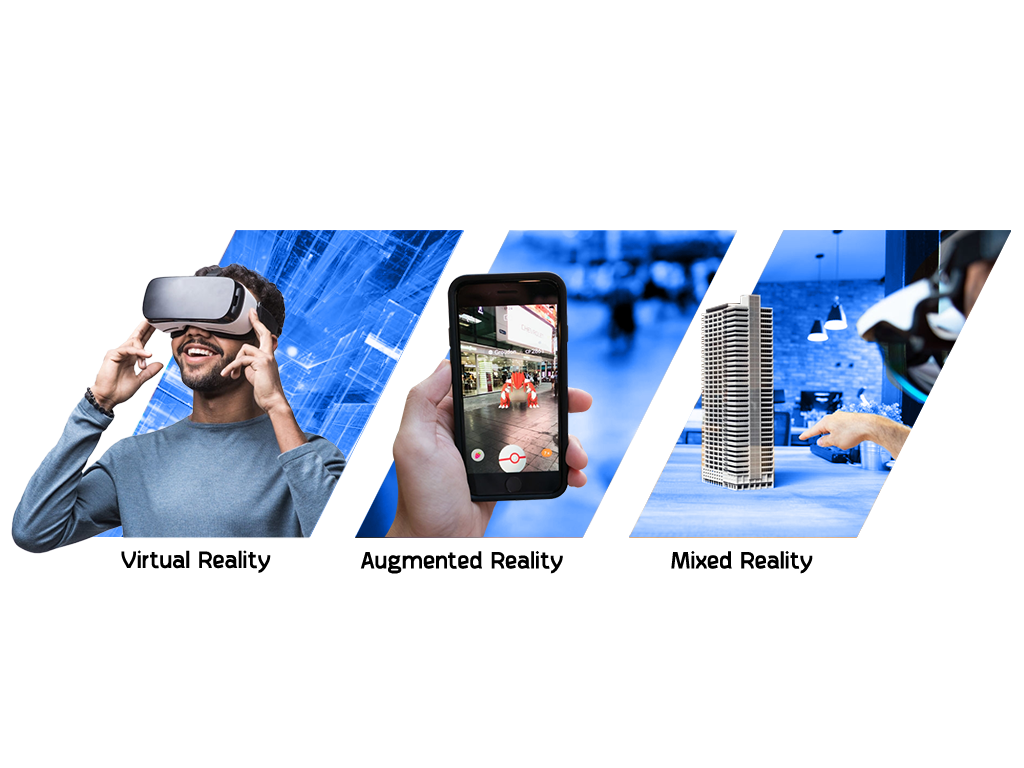



Businesses now expect digital experiences to be faster, more personal, and more engaging. AR (Augmented Reality) and VR (Virtual Reality) are two of the strongest technologies to accomplish that—because they move beyond screens and create interaction in space: either by overlaying digital information on the real world (AR) or by placing the user inside a fully simulated environment (VR).
What makes AR/VR powerful is not the “wow factor.” It’s the measurable impact: fewer training errors, safer simulations, faster onboarding, stronger product understanding, and better customer confidence. If you want to reduce friction in how people learn, buy, maintain, or operate—immersive technology can be a competitive advantage.
Choosing the right approach is the first success factor. Many initiatives fail because teams start building before they clarify the experience type, the user environment, and the device constraints.
AR/VR succeeds when it solves a high-friction process—something costly, risky, repetitive, or difficult to explain with traditional content. Below are common, high-impact scenarios.
We build immersive applications end-to-end: discovery, prototyping, development, optimization, QA, deployment, and post-launch support. The exact solution depends on your industry and target device, but the delivery principles remain the same: performance, usability, stability, and measurable outcomes.
What we can deliver
The “best” tool depends on the platform, performance target, and the type of tracking or rendering you need. We select tools based on your scenario and device landscape—not hype.
Apple ARKit
ARKit is a strong choice for iOS-based AR experiences. It enables world tracking, plane detection, scene understanding,
and advanced features such as face tracking and image/object recognition depending on the device capabilities.
ARKit works well for premium consumer experiences, retail visualization, and iOS-first product demos.
Google ARCore
ARCore is the Android counterpart for motion tracking, environmental understanding, and light estimation.
It’s widely used for mobile AR and supports common scenarios like placing 3D objects in real space, measuring,
and creating interactive overlays.
Vuforia
Vuforia is popular for marker-based experiences, image targets, and object recognition. It is often used for industrial
and enterprise AR where tracking reliability is critical. Vuforia also integrates well with engines like Unity.
Wikitude / Location-based SDKs
For location-driven AR (geolocation, mapping overlays, points of interest), location-based SDKs can help deliver
outdoor experiences such as events, tourism, learning paths, or logistics tracking scenarios.
Unity
Unity is widely used for AR/VR because it supports rapid iteration, cross-platform builds, and a large ecosystem.
It’s a strong choice for training simulations, interactive product demos, and real-time 3D experiences.
Unreal Engine
Unreal is preferred for experiences where visual fidelity, cinematic lighting, and high-end real-time rendering matter.
It can be a great fit for premium showrooms, architecture visualization, and marketing-grade VR experiences.
Blender (3D asset pipeline)
High-quality VR/AR depends on optimized 3D assets. Blender can support modeling, rigging, animation,
and iterative asset optimization—especially when paired with a disciplined performance pipeline.
AR/VR is unforgiving: if performance drops, immersion breaks and users lose trust—or feel discomfort. That’s why our delivery focuses on technical and UX fundamentals that protect the experience.
We use a staged approach that reduces risk and ensures you don’t over-invest before proving the concept. Most AR/VR initiatives benefit from early prototyping and testing in the real operating environment.
1) Discovery and Use-Case Definition
We clarify the primary outcome, user journey, device constraints, environment conditions, and success metrics.
This is where we decide AR vs VR (or hybrid), content needs, and integration boundaries.
2) Prototype and Experience Validation
We build a lightweight prototype to validate tracking, interactions, performance, and user comfort.
Stakeholders can see and test the core experience before the full build begins.
3) Production Development
We implement core features, content pipelines, backend integrations (if required), analytics/telemetry, and admin tooling.
We iterate in short cycles so you can review progress regularly.
4) QA, Device Testing, and Optimization
We test across devices, environments, and edge cases. For immersive apps, performance testing is not optional.
Optimization includes rendering, assets, memory, and input responsiveness.
5) Deployment and Continuous Improvement
We support store submissions (when applicable), enterprise distribution, monitoring, and post-launch enhancements.
We also help you plan content updates so the solution stays relevant.
When selecting an AR/VR direction, the question is not “which tool is best?” The real question is: “what environment and behavior do we need to support?” Here are the decision anchors we use with clients:
The future of AR and VR is bright because it changes the way people learn, understand, and decide. Whether you want a training simulator, a product visualization tool, or a customer experience that stands out, we can help you design and deliver an immersive solution that performs in the real world.
Contact us today and we’ll propose the right direction—platform, tools, scope, and delivery plan—based on your goals and constraints.